Security and Self-Defense Gaps
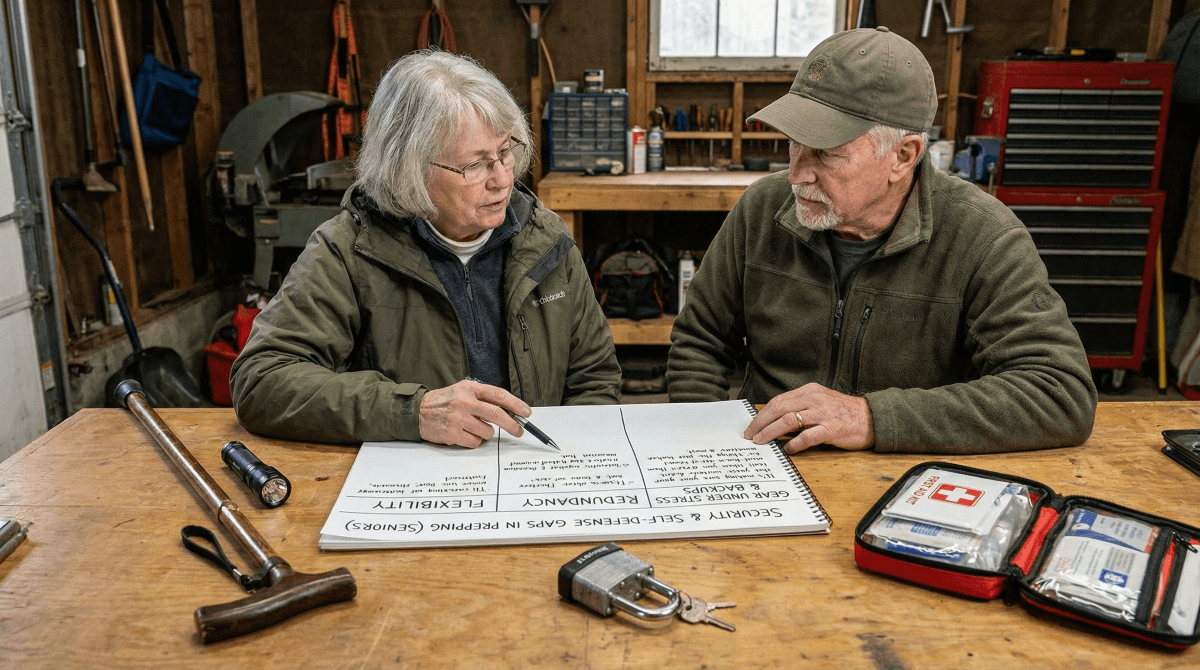
What are your plans for security and self-defense as a senior in survival mode?
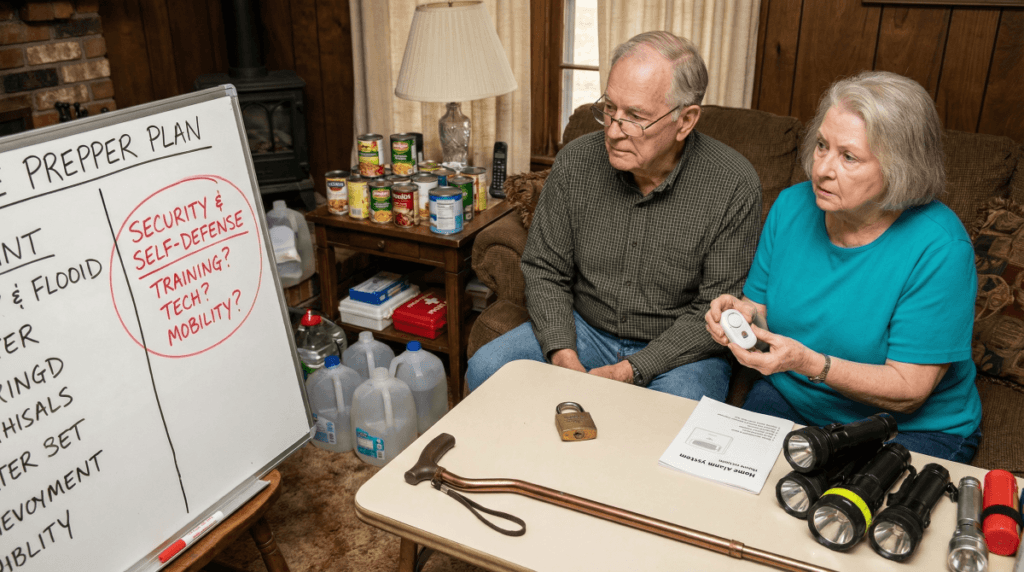
Most people think security means having a weapon. They buy a gun, maybe a knife, and assume they’ve covered it. But real self-defense is a system, not a single tool. It’s what you carry, how you carry it, where you store it, what you train with, and how you recover from failure. This is the ninth section for Key Survival Gear Seniors Often Forget.
The In-Between Gap Most Preppers Ignore
It’s also how you avoid a threat entirely. Violence isn’t always the answer. Most of the time, it’s a last resort. But when prepping plans talk about security, they skip over the in-between—the gaps that sit between passive safety and full-on armed conflict.
TL;DR Security and Self-Defense Gaps (Section 9)
Real self-defense isn’t just owning a weapon. It’s a system that helps you avoid trouble, buy time, and stay in control.
- Think layers: deterrence first, defense second, deadly force last.
- Non-lethal matters: pepper spray, alarms, and low-profile tools can stop threats without escalation.
- Carry can fail: holsters, clips, belts, and sheaths break—build backups and test your setups.
- Training + maintenance: clean, repair, and practice under stress so gear works when you’re tired or hurt.
“Quiet readiness beats flashy force. Build a system that buys you seconds to run, hide, or think.”
That’s where most people fail. Not because they don’t care, but because they don’t think through the small things that add up to real preparedness. Security isn’t just about stopping danger.
Related: How to Avoid the Most Common Prepping Mistakes
Security Is a System, Not a Weapon
- It’s about staying in control, about slowing people down, buying time, creating space, and reducing risk.
- It’s about being ready for conflict without inviting it.
- Being hard to surprise, hard to steal from, hard to pin down.
It’s about options. Flexibility. Redundancy. It’s making sure your gear works under stress, that your tools don’t fail when you draw them, and that you have backups for what matters most. That means looking beyond the obvious and preparing for what most people forget.
Non-Lethal Defense: Control Without Escalation
Non-lethal defense tools are a huge blind spot. Everyone jumps to firearms, but guns aren’t always the correct answer. They’re loud, they draw attention, and they require a higher level of commitment and legal awareness.
Examples of non-lethal defense tools:
- MUNIO Self Defense Keychain
- Stinger Personal Safety Alarm
- 2-Pack Yawara Stick – Koga SD1 Palm Stick Set
- Stinger Duron Steel Drill POM
- Heavy Tazer Stun Gun
- 2 Pack Splatter Stream Pepper Spray
- Stun Gun for Self Defense
- Pocket Knife, Folding Knife with Clip
In a survival situation, especially one involving civilians or temporary breakdowns, non-lethal options can give you a defensive edge without escalating things to deadly force. Pepper spray, for example, creates instant distance.
Carry Failure Is a Security Failure
It incapacitates an attacker long enough to escape or subdue them. It’s legal in most places, lightweight, and easy to carry. But it has to be accessible. Buried in your bag, it’s worthless. Clipped to your belt or stashed in a coat pocket, it’s a lifesaver.
Personal alarms are another tool people overlook. You pull the pin, and they scream—loud enough to disorient or scare off a threat, attract help, or alert your group to danger. They work exceptionally well in camps, with children, or in urban survival where visibility is limited but sound carries.
Even if no one comes to help, that piercing noise can change the behavior of someone who thought they had the upper hand. It draws attention in a way that makes criminals hesitate.
Tactical pens are more than a gimmick. They’re legal in most places, don’t raise eyebrows, and double as both writing instruments and defensive tools. With a solid metal body and a pointed end, they can break glass, deliver focused strikes, or be used in grapples when knives aren’t an option.
Related: What’s the Difference between Smart Prepping and Paranoia?
You can carry one through most checkpoints without hassle. And unlike a knife, they don’t require the same level of commitment to use. In close quarters, a strike with a tactical pen to the throat or temple can create just enough advantage to escape or counter.
But none of these tools matter if you can’t carry them consistently. That’s where spare holsters, belts, and sheaths come in. Everyone preps the tool, but not how they’re going to wear it.
- Holsters crack.
- Clips break.
- Velcro fails.
- Sheaths tear.
- Belts stretch or snap under weight.
If your everyday carry falls off your body mid-run, that’s a problem. If you draw and the holster comes with it, you’re fumbling in a critical moment.
You need backups—different styles for different seasons, gear loadouts, or injury. A belt sheath isn’t helpful if you’re not wearing pants with belt loops. A shoulder holster won’t work if your jacket’s too tight.
Test your setups. Move in them. Sit, squat, lie down. Roll. Can you access your tools easily? Can someone else grab them faster than you can? What if your dominant hand is injured?
- Do you have cross-draw options?
- A spare holster in your pack,
- a backup sheath in your glove box,
- an extra belt in your shelter—all of these fill a gap you won’t notice until it’s too late.
Security gear fails when it’s assumed to be permanent.
Gear Maintenance and Training Gaps
Range tools and repair kits are another critical area most preppers ignore. Owning a weapon isn’t enough. You have to keep it functional. That means cleaning kits, spare parts, and practice tools.
Gun cleaning supplies should be standard in every prep plan, but most people either forget them or buy cheap kits that fall apart. You want bore snakes, oil, brushes, patches, and backups of anything that wears down—springs, pins, even optics batteries. You can’t shoot what doesn’t cycle.
Related: If You Could Only Pick One Bug-Out Bag Item, What’s the Ultimate Must-Have?
Practice ammo matters too, especially alternatives like airsoft. When real ammunition is scarce, expensive, or too dangerous to waste, airsoft lets you keep training muscle memory. Drawing, aiming, trigger control, movement—those are perishable skills.
You can’t afford to lose them in a high-stress situation. And for groups with kids or less-experienced members, airsoft training becomes an easy way to introduce weapon handling without the risk.
Slingshots are another underused tool. Silent, reusable, and low-profile, they’re good for hunting small game or deterring animals—or people. They don’t scream “weapon,” but in the right hands, they’re powerful.
People don’t train enough with their gear. They think “owning” equals “ready.” It doesn’t.
- You have to train dirty.
- Train tired.
- Train while wearing gloves,
- while injured,
- while running.
If your sling snags, if your knife sheath rotates when you grab it, if your flashlight clicks the wrong direction—you need to know now. Not when you’re cornered. Not when someone’s breaking in. Your gear doesn’t work because you bought it. It works because you practiced with it.
Identity, Authority, and Psychological Security
Identification tools might not sound like security items, but they absolutely are. When things break down, you want proof of ownership. You want to label gear, mark territory, and protect against theft or confusion.
Engraving tools let you etch names or codes onto tools, weapons, electronics, and supplies. Asset tags—small, adhesive barcodes or ID labels—can help you catalog and track your gear. In shared camps or group settings, it’s easy for things to get “borrowed” or mixed up. Marking your items clearly helps you reclaim them without arguments or uncertainty.
Laminated copies of important documents are also a defense tool. In a disaster, you might have to prove identity, custody, ownership, or qualifications. Carrying originals is risky—laminate copies of IDs, licenses, deeds, prescriptions, and permits.
Store them in waterproof sleeves. If you’re traveling or evacuating, these give you authority and mobility. If you’re stopped at a roadblock or need access to restricted areas, documents can mean the difference between passing through or being detained.
Identity isn’t just about paperwork. It’s about situational authority. If you’re running security in a camp, working as a medic, or helping organize supplies, printed ID tags, armbands, or laminated role cards can give you legitimacy.
People follow structure when they’re scared. Visible signs of role or ownership reduce confusion, prevent panic, and make you less likely to be challenged. Security is psychological. The more in control and prepared you appear, the less likely people are to test you.
Related: Mind Over Matter: Forging a Fortress of Mental Fortitude
Security Changes as the Threat Evolves
Security isn’t static. It changes with the threat. Day one of a crisis looks different than day ten. Early on, you’re avoiding chaos. Later, you’re protecting what you’ve built. In the beginning, noise is danger.
Later, silence might be what draws attention. The gaps between defense levels are what matter most.
- Can you de-escalate?
- Can you deter without drawing a weapon?
- Can you protect your perimeter without creating a confrontation?
- Can you carry your gear without being obvious?
Prepping for security means prepping the soft edges as much as the sharp ones. Think layers.
- Deterrents first.
- Defense second.
- Deadly force last.
- Build systems that
- delay threats,
- reduce visibility,
- and give you time to act.
Use tools that work when you’re tired, injured, or alone.
- Assume the gear will fail and have backups.
- Assume plans will fall apart and have redundancies.
Protect your identity, your gear, your access. Don’t rely on luck or good intentions. Rely on preparation.
Quiet Readiness Beats Loud Force
Most people get stuck in one mode. Either they go full combat loadout or pretend that nothing will ever go wrong. Neither is right. The honest answer is in the middle. Quiet confidence.
Silent readiness. Gear that works because it’s been tested. Tools that blend in until they’re needed. Security gaps don’t announce themselves. They show up in the middle of the night, when you reach for something, and it’s not there. When the holster snaps. When the belt’s too loose. When the ammo jams. When your flashlight dies, that’s when you find out what you forgot.
So plan ahead, not just for the fight—but for everything around it.
- What happens after?
- What happens before?
- What keeps you safe without making you a target?
- What buys you five more seconds to run, hide, or think?
That’s the real prep. That’s security. And if you build it now, it won’t fail you later.
Comments
What’s your take on this? Do you have all of your prep planning done? Do you feel like you could do more? Do you have tips, tools, or stories that could help fellow Golden Survivalists? Drop a comment below—your insight might be precisely what someone else needs. I read every comment and reply when I can. Let’s learn from each other.
Next up is Go Mobility, Evacuation, and Recon Items